
I like to chat with my dad about work and hear stories from his childhood. Like the one about his first job shooting gophers. Another story, a darker one, has his merry gang of friends riding bicycles around the countryside, on dirt roads and between woody hills. They’re chasing planes that fart orange clouds. It sounds like a scene from a Dr. Seuss book – that is, until my dad drops the twist. Those clouds were made up of aerosolized DDT, refracting dusty twilight, left behind by crop dusters finishing their last flight of the day.
When we treat problems in our life directly and aggressively, opportunities can get caught in the crossfire. It’s often smart to delay reaching for final solutions. This chapter explores how people use the image of a seed to think about indirection, strategy and changing the world – and how it helps them become more patient in the process.
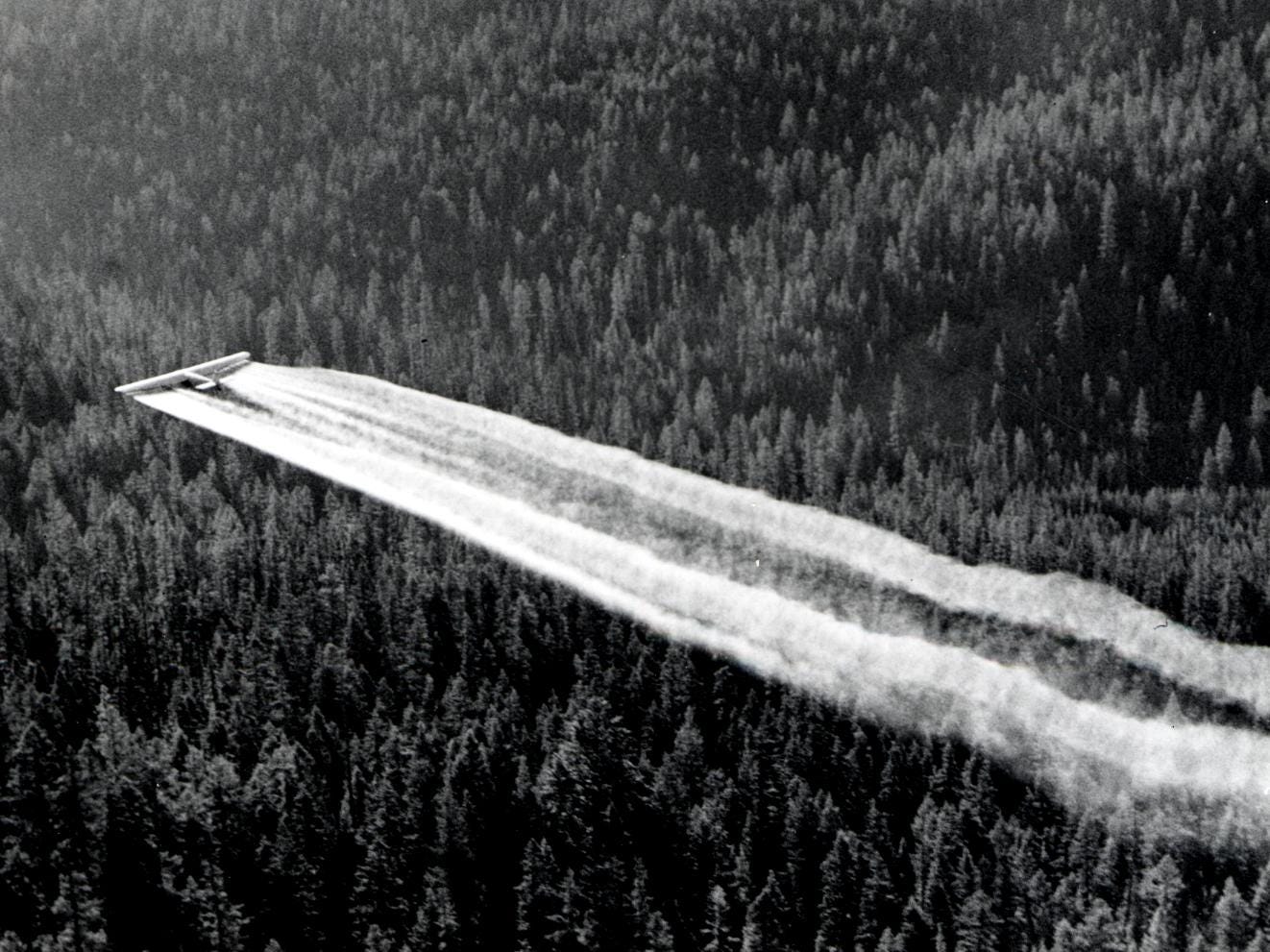
Dichloro-diphenyl-trichloroethane (DDT) was a potent insecticide. Its deadly effect on pests made it important during the two world wars – helping prevent the spread of disease among soldiers, as bugs and rats were primary vectors. Agricultural enterprises also adopted DDT as a way to eliminate plant-destroying insects. Crop yields improved more or less overnight.
However, in the 1970s, DDT was banned. Rachel Carson’s exposé, Silent Spring, alerted the world to the profound and long-lasting consequences of toxic insecticides – including cancer.
The utility of DDT didn’t outweigh its mutility and, once again, through the pursuit of a total and final solution, we created a new class of problem. In this case, we flooded our food supply with bioaccumulating, cancer-causing chemicals. This is a common pattern.
Symptom appears
Eliminate root cause
Symptom disappear perfectly
Nasty, iatrogenic effects appear
The first-order logic of insecticide is seductive. Seeds are amazing, but relatively delicate. They contain a mind-blowing quantity of information that somehow unfolds into an organism several thousand times its original size. Whatever kind of crop you are trying to grow, seeds are the beginning and end of the cycle. They are the first layer of indirection. Any small changes you can make to seed survival rates or growth rates translate into big wins on yield. It’s natural that we possess a strong desire to eliminate any potential threats, once and for all.
Identifying the Image
The seed is a rich and familiar metaphor, often deployed in the world of work as a means of thinking about indirection – and I’m sure you’ve heard it used before.
“Let’s plant a seed with so-and-so about this initiative, then circle back in a few weeks.”
“This division is a good testbed for that new software.”
“We need to nip this in the bud before it grows out of control.”
“A rotation program would be an effective way to have our best talent cross-pollinate.”
Phrases like these bring to mind a particular mechanism of change: that of a tiny seed, which has the potential to grow and spread, and even to terraform the entire landscape of a business. The image opens up a new possibility: rather than changing things through force, you could change them by altering the code of things around you.
It’s common for teams to frame new ideas, initiatives or ventures as a seed. Leverage is still a more common metaphor, but it’s interesting for exactly the opposite reasons as this image. Using it leads to different strengths and blind spots; those who think like foresters are less easily seduced by final solutions; others fall into the trap of naïve evolutionary thinking.
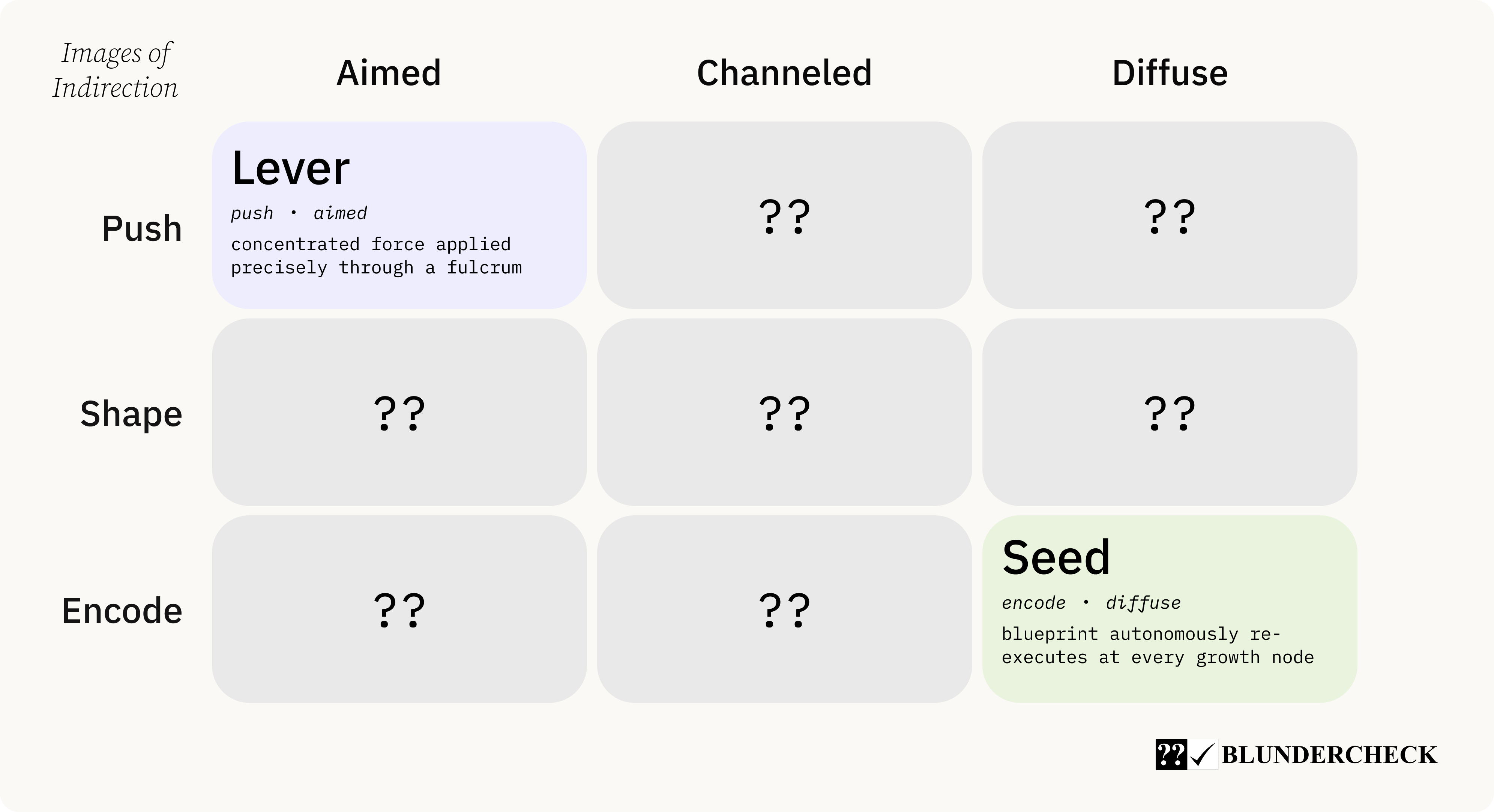
Having a healthy analogical range can help you make creative strategies. The Seed is a complement to the Lever in your starter pack, thanks to the two images having inverted logics (Lever: push x aimed, Seed: encode x diffuse). Plus, biomimicry is an established trick in organizational design, so the Seed is both easy to grok and go deep on. There’s plenty of reading available – from classical management theorists like Henry Mintzberg to the more trippy thought leaders of the late '90s, like Stewart Brand.
Let’s get into the details of our second Image of Indirection before examining its strengths and weaknesses.
Infringing upon Mother Nature’s Copyrights
While I dislike Henry Mintzberg’s silly use of the word quantum, his writing about management holds up. In a 1987 HBR article, Crafting Strategy, Mintzberg illustrates the difference between treating strategies like tomatoes grown in a greenhouse in pristine conditions versus treating them like weeds (dandelions, specifically). I’ve worked with many people who are fond of using organic analogies to break away from typically mechanical ways of thinking about indirection. And it’s usually easy to identify which page – tomato or dandelion – they tend to borrow from Mother Nature’s playbook.
Tomato growers use indirection in a thorough way. They meticulously adjust the greenhouse in order to create optimal growing conditions for a handful of carefully selected (or even modified) seeds. Pests, cold weather and competing species are kept out of the greenhouse. Mintzberg notes that this mindset tends to grow good tomatoes, but might not produce a strong tomato plant. This is how some excellent marketers work: they pick promising anecdotes, remove them from their context and grow them into something special.
Dandelion-types prefer a more efficient approach, where strategies grow like weeds in an organization. Since you cannot, according to Mintzberg, distinguish between good and bad strategies at their conception (at the seed stage), you must allow them to grow before taking your pick of the crop. This has downsides, too, like the cost of observing all of the strategies growing at any moment. Venture capitalists have solved the observability problem with term sheets, which give them legal rights (equity) to winning weeds (startups).
It’s a fun game to sort your colleagues into the Tomato and Dandelion buckets, but the real point here is that the Seed is a classic and widespread image of indirection, with its own theory of change.
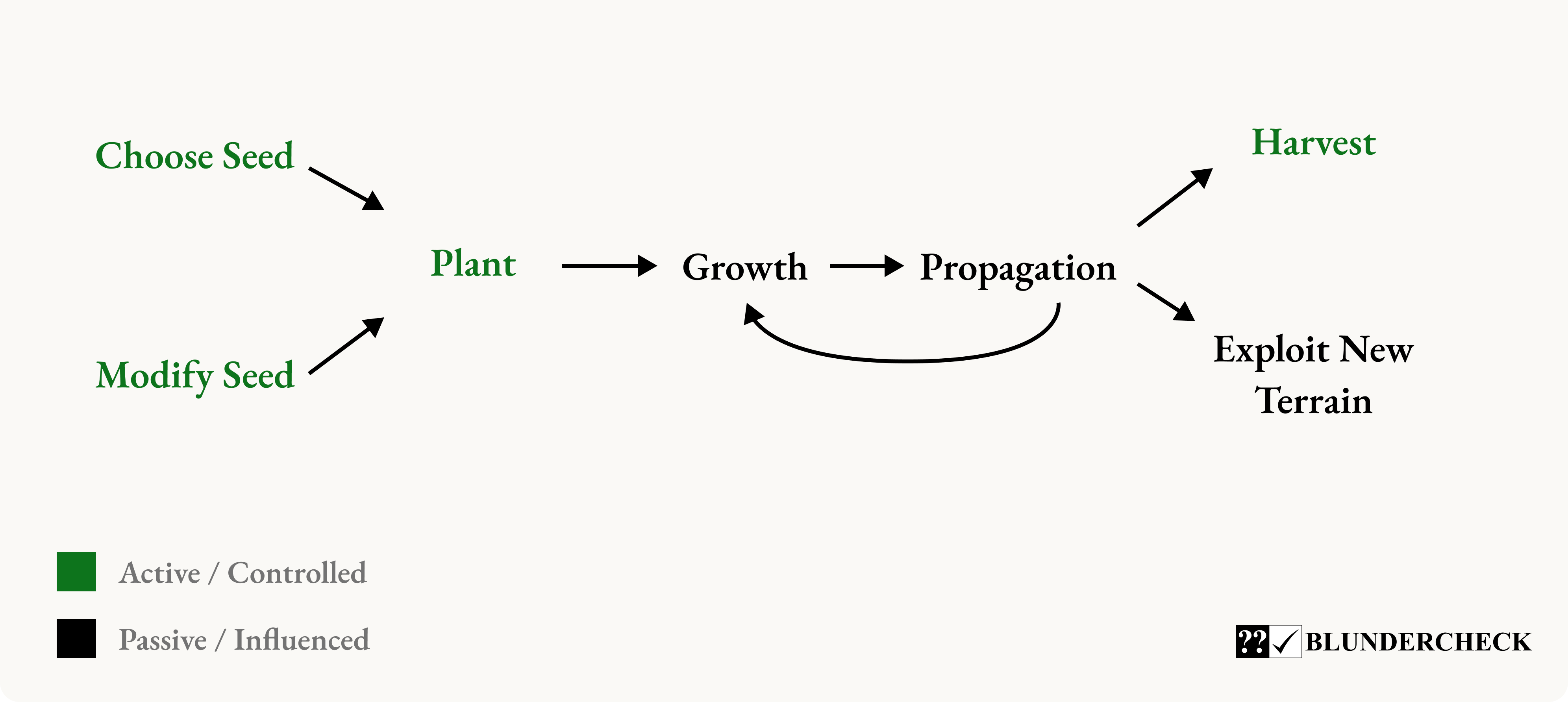
In our taxonomy, this image sits at Encode x Diffuse. The initial action is Encode; inject a packet of information into the environment. That packet contains some “code”, which allows it to grow, affect its surroundings and, importantly, propagate across settings. Once released into the world, these packets execute their blueprint repeatedly and autonomously, to the extent that environmental conditions are favorable.
Sometimes conditions are extremely conducive to growth, as one might see with an invasive plant species like Scotch broom. What entered Washington State as a singular, tiny seed has now terraformed the entire landscape. This is why the seed image fits into the Diffuse column. For what you gain in efficiency (seeds are small, dense and can be self-sustaining) you lose in control.
Attempts to achieve direct command over the outcome of a seed tend to have nasty second-order effects. Such was the case with DDT. Mintzberg makes the case that weeds are a far more realistic depiction of the processes through which strategies are formed, where the role of a strategist isn’t to 3D print a perfect tomato, but to plant seeds, create conditions conducive to growth and pay attention to what emerges.
Strengths and Weaknesses of the Seed
These strengths and weaknesses are to help you understand the limitations of popular mental models – not to establish a winner.
Strengths
Discourages final solutions and promotes management instead. In the context of an organization, this preserves optionality – and therefore the ability to change.
Balances the mechanical view of work, of inputs and outputs, which we inherited from the 19th- and 20th-century theories of management. Creative work in particular requires discontinuous methods and defies simple divisions of labor.
Orients you towards two important focus points – content and context. Content is what you can control, like product characteristics or characters in a narrative. Context, the environment that a seed must grow in, is something you can merely monitor, and sometimes influence.
Forces you to compress ideas. The image of a seed is that of a maximally dense tangle of data that unfolds into a living organism. The lighter and smaller you can get an idea, the further it can travel.
Enriches your analogical range. The space of adjacent concepts, including forestry, gardening, jungles and bugs, is rich. For some modern examples, see: Of Termites & Tokens, Only Openings and Black Swan Farming.
Weaknesses
Lures people into an anarchic standpoint, from which they perceive workplaces as peaceful gardens full of wise, decent and mutualistic species. In reality, plants fight to the death over limited space and against insects. Seeds might be cute little plant babies, but there is a necessary degree of structure and responsibility required for their success.
Suffers from poor observability. Seeds diffuse into the landscape, slowly grow, then diffuse again. They are cheap to deploy but expensive to observe. When a project is designed in the image of a seed, more energy tends to be invested into encoding the seed rather than determining a follow-up strategy.
Appears simpler than it is. Most thinkers using this image do not differentiate between the different types of seeds. In biological terms, there are three types of seeders: C-, S- and R-strategists. I’ve explained these at the end.
Smuggles in the naturalistic fallacy: because nature is the result of 3.8 billion years of evolution, it’s easy to assume that copying it is the right move. However, recycled patterns carry assumptions about context. A (mostly) failed instance of indirection was the paleo health movement, which suggested that we adopt ancestral lifestyles. That ship has sailed. Not only is our environment irreversibly different, it is also objectively better in many ways. Do not equate natural with good.
Using the Image
The point of metaphor is to think creatively about something – to make a discontinuous leap in logic that helps you win. However, especially with metaphors that have a lot of hidden details, it can be nice to have a couple of proven templates.
Modern plant strategy work suggests that there are three types of seeders: Competitors (C), Stress-Tolerators (S) and Ruderals (R). This is based on the theory that plants navigate disturbance (like grazing, fire, pests) and stress (resource limitations).
Competitors (C), such as oak trees, seed into densely populated environments where new plants must grow quickly to monopolize resources. Seeds are evolved for early and rapid growth.
Stress-Tolerators (S), like cacti and shrubs, handle stress well, but exist mainly in stable environments. Seeds must withstand drought, heat and cold.
Ruderals (R), including dandelions and other weeds, are fast-growing, short-lived and rely on huge seed volumes with low individual survival rates.
Irrigation is another one of my favorite templates. Rather than aim for a stable configuration of species and invest into specific individuals, you focus on saturating areas of interest with the ingredients for success. Control and planning are expensive. Providing resources without tight oversight will always produce losses, but it’s worth considering if those losses are lower than the costs of administrative overhead and of maintaining accurate knowledge of the area of interest. I’ve seen a handful of projects fail because they were too selective upfront.
Sometimes, the goal is not to reap what you sow, but to seed a new landscape altogether. Consider a watch company that relies on a single manufacturer for a certain sensor. Imagine that watch company develops a new sensor technology, but makes it open-source. What happens? They plant a seed that can grow into a competing sensor supplier, driving down prices for a critical component of their watches.
Using the seed as an image of indirection was part of a needed diversification. Machines and mechanisms captured our imaginations during the 19th and 20th centuries. Seeds offer a fresh foil for thinking creatively about achieving big things. However, personally, I think we’re close to the peak of this analogy – naturalistic thinking is widespread and a little naïve. Evolution is a great theory but a borderline useless concept in practice, where you don’t get multiple generations of efforts. And don’t even get me started on all the people using the word “metabolism”…
But perhaps this image’s biggest strength is its discouragement of final solutions. I think people often rush into problems intent on solving them once and for all, when they should perhaps simply be managed. I talk more about this in The Voyage of Theseus.
Now that we have our feet planted firmly in either corner of the taxonomy, it’s time to dive into the remaining seven images of indirection: River, Virus, Gravity Well, Lens, Domino, Clock and Catalyst – some of the most common mental models for oblique problem-solving.
“Terrariums are an indirect way of bringing nature closer and are a good reminder of just how much lies beyond our control, such as how plants grow. We can only take an indirect approach to growing: water, fertilize, and otherwise tend the plants. The rest is up to God and nature.” – Steve Brock
P.S. Hellooo, and thank-you, to the 77 new subscribers since the last post dropped.
I like the seed as a metaphor how change can spread without being fully directed.
It also made me think of the rhizome. Not something planted in one place and then spreading outward. Rather, change is happening through many connections at once without a clear origin.
That sort of suggests a different strategy too. It would be less about deciding what to plant, more about seeing what is already connecting or rather, where something is already moving.
And then see what might happen if those connections are strengthened.
tl;dr --> maybe it's not always about starting but noticing where something is already beginning.
Also: this metaphor explored in my Innovation Tactics deck:
https://www.dropbox.com/scl/fi/78k81681498dl0cxse69y/Focus-Seeds-vs-Soil-Front.png?rlkey=smnm5jggpbvy25u4fnacg86mb&st=qbpsqp37&dl=0
https://www.dropbox.com/scl/fi/cm92ixb36e5jk2gbxx4ph/Focus-Seeds-vs-Soil-Back.png?rlkey=i6hf5nvz2anbwrshrz0cl5dy8&st=03r2x0uz&dl=0