
Leverage is the oldest and most popular mental model of indirection in the world of management. No doubt you’ve encountered it many times in boardrooms, memos and strategy documents alongside phrases like return on investment. That’s no big surprise, given that leaders in both government and industry constantly face pressure to do more with less. Nearly all books on management written in the 20th century feature levers prominently as metaphorical aids to their core arguments. Our first image of indirection, the Lever, deserves a lot of credit not just for its utility, but also for its popularity.
Even as children, we quickly intuit the dynamics of simple machines like the lever and its fulcrum. Almost everyone has pried open a lid or rocked a seesaw. This shared, almost magical experience of mechanical advantage makes the lever an ideal starter image for more difficult problems in work and life. Indeed, Archimedes’ famous quote inspires many to dream big from a young age.
“Give me a lever long enough and a fulcrum on which to place it, and I shall move the world.”
However, this quote is both a blessing and a curse. Like any metaphor for indirection, the Lever has several persistent blind spots. Even if you don’t wish to expand your repertoire, you should know how to wield this image. Carefully, like a sword that cuts both ways – not just a blunt instrument.
In this chapter, we’ll dive into the strengths and weaknesses of the Lever image, and dip briefly into its long history. But before we start, it’s time to introduce the taxonomy behind Images of Indirection. During my initial interviews it became clear that managers and knowledge workers tend to have a 2-4 image repertoire and there were some nascent clusters emerging. Those clusters mapped nicely to two axes: Driver – what drives the initial effect and Relay – how the initial effect finds and affects its target.
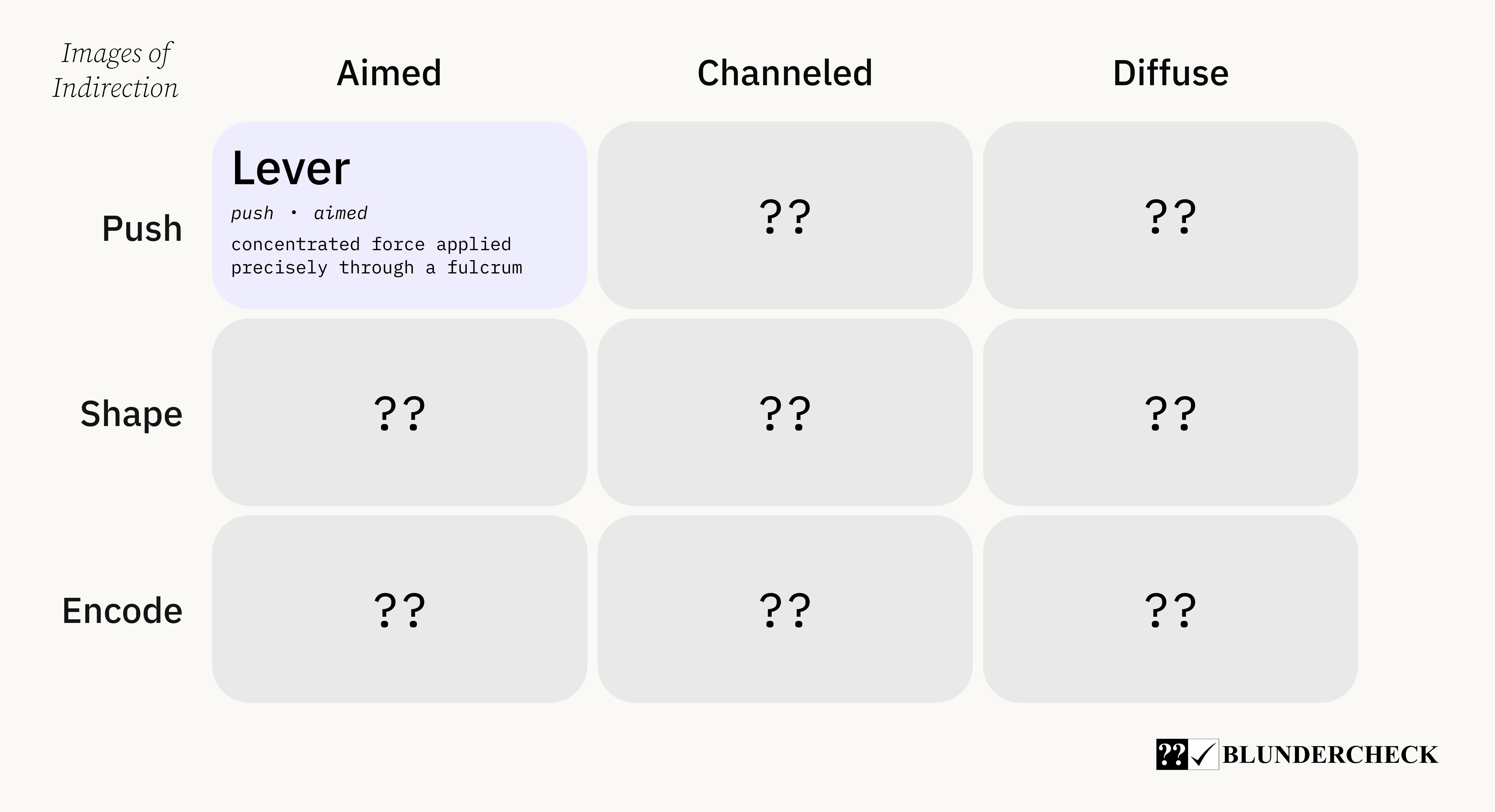
Each image has a unique combination of Driver and Relay types, which together explain in which contexts each image tends to (under)perform. Each Driver type – Push, Shape, Encode – describes the initial move made by the actor in the system. The spectrum of Relay types – Aimed, Channeled, Diffuse – characterize how the initial move routes to its target and what is affected along the way. By mapping the nine images of indirection according to these types, the grid layout reveals if your default way of thinking about indirection is specialized or diversified. You might prefer Aimed images that map nicely onto real-world metrics. Or all of your analogies could be computer-like, fitting into the Encode row. Perhaps you have your own metaphors, which I haven’t named in my set of 9, but that still fit nicely into the grid.
By the end of the series, this taxonomy will comprise a complete framework. Beyond the individual deep dives, the whole set should be helpful in a few ways: i) to spot patterns in how you think about change, ii) as a structured exercise to augment your planning process and iii) as a “periodic table” that you can use to upgrade your literacy and help others think about indirection.
For the record, these are the same things I’m hoping to get out of this project. I want to be practical AND dangerously creative.
An artifact of mechanical thinking
I was once in a boardroom where an executive said, “We should take stock of the levers that we have available to us.” Their team was proactively managing fallout from a reorganization project, which was expected to be unpopular with staff. That phrase could not have been more on the nose. It’s representative of how many executives picture their role in an organization: at the helm of the vessel, looking at their dashboard, instrument panel and an assortment of levers.
Since the industrial revolution it’s been common to portray organizations as machines. And the ability of a manager – the driver of the machine – is a function of the quantity and quality of levers available to them. Robert McNamara, briefly president of Ford and former U.S. Defense Secretary, was the epitome of mechanical thinking.1 From industry to government, he insisted upon collecting data as a way to uncover the most effective levers available, to improve the furnishings of an organization’s cockpit. While McNamara’s particular track record is spotty, particularly in the case of his involvement with the Vietnam War, this style of management – and its default image of indirection – has had its successes. An outright focus on just a couple of effective activities can lead to great results.
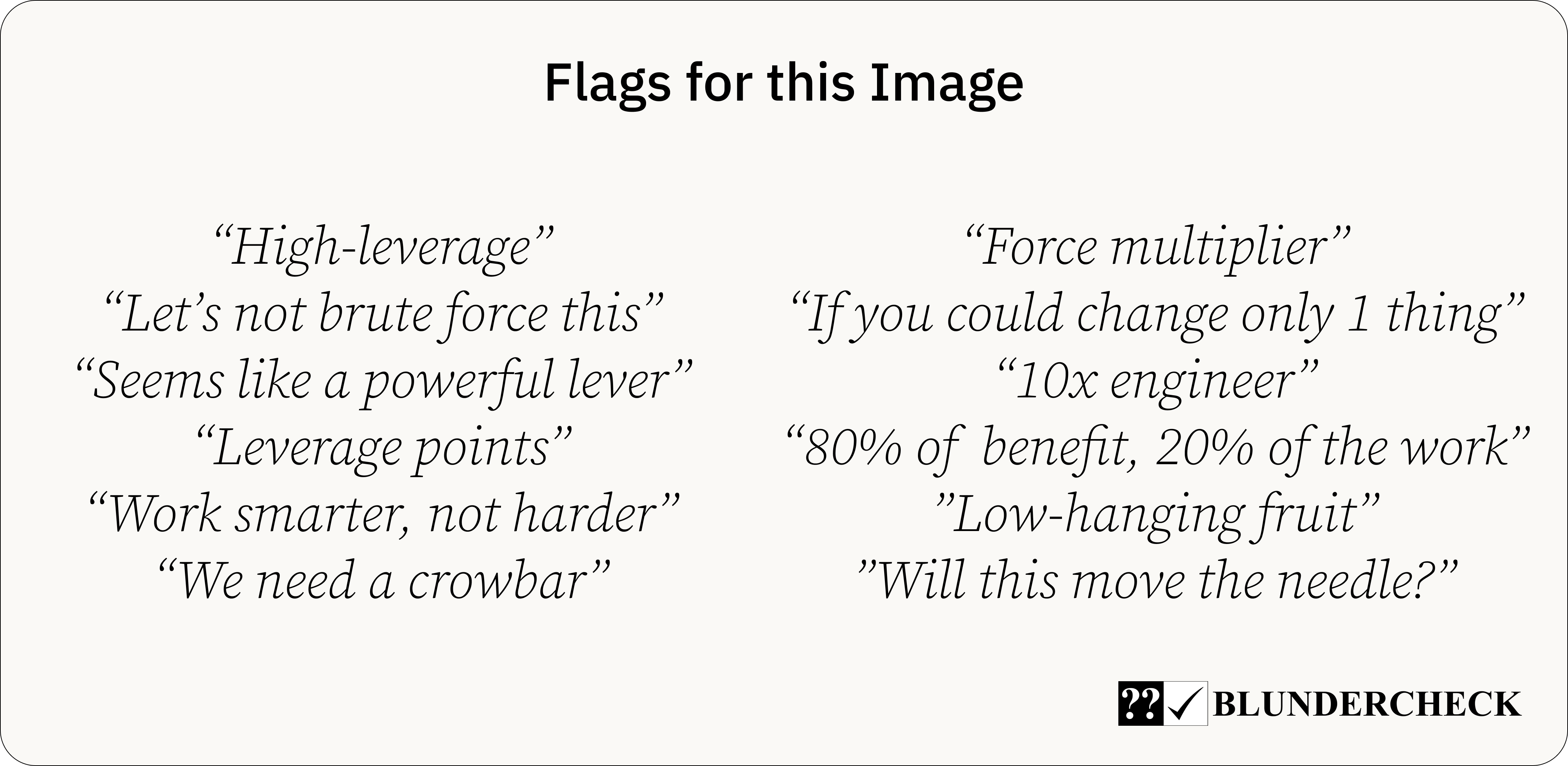
Andy Grove’s High Output Management is likely the most explicit and influential formalization of the lever metaphor.2 He published the book in 1983 and titled chapter 3 “Managerial Leverage”, defining leverage as the relationship between a work activity and its level of output. High-leverage activities generate high levels of output; low-leverage activities, a low level of output. He even turned it into an equation (L1 x A1 + L2 x A2 + …) that sums leverage coefficients by their activities. This equation is just as popular and useful as it is wrong and illustrative of this image’s biggest weaknesses.
Grove claimed that mechanical advantage exists in organizations and can lead to disproportionate returns on investment. I’m paraphrasing, but variations of this claim are widely accepted. If you push in the right place, you’ll beat someone who applies force in a less intelligent way. Thinkers like Andy Grove, Richard Koch, Donella Meadows, Joseph Juran and Michael Porter all popularized the use of leverage as a mental model, including the notion that identifying leverage points is a skill that can be developed. They were right, too – to this day, this frame leads many people to discover clever ways of improving organization, increasing profit and making bigger impact.
However, the image of the lever contains very strong assumptions about the world and it fails miserably in certain contexts.
Strengths and weaknesses of the lever as an image of indirection
A lever possesses several components and characteristics which make it an efficient, simple machine:
An arm (the lever itself) which is of a certain length and, most importantly, extremely rigid and strong.
A fulcrum, around which the lever arm rotates, providing usually just a single axis of range. Most levers go up and down, like a seesaw.
One side upon which rests the object of change, like a very large boulder, or a pallet full of bricks, or a conceptual change object like a company’s reputation or a country’s birth rate.
A force that acts upon the side opposite of the change object.
The simplicity of the lever is part of what makes it such a great metaphor. It’s portable across contexts from policymaking to investing in financial markets, to more mundane settings like loading a stove into the back of your buddy’s truck. In our taxonomy, the Lever is an Aimed Push. You have a specific target and you apply force locally, at a connected target, in order to achieve your bigger, more ambitious goal indirectly.
An investor can turn a 1% return into a very, very large financial gain in nominal terms by using debt to increase the size of an investment, like shorting some shares of Acme Co. This is called leveraging up and works by extending the length of the lever arm. Debt allows you to easily short 10x more Acme Co. shares. But the beauty of a lever – that it faithfully transmits force from one end to the other – is also its primary weakness. The image of a lever assumes that there exists a tightly-coupled chain of events that connect the initial force (in this case, the purchase of shorts) and the outcome (the stock price). Contract law does that to investors, which is why a very small decrease in investment value was enough to bankrupt Lehman Brothers during the great financial crisis.
This assumption of tight coupling holds across all contexts where we imagine indirection as a lever. The mental model fails both when leverage turns negative and catapults you off your end of the seesaw, and when there actually isn’t a rigid lever. Going back to the case of McNamara, his views influenced the Ford company to issue an edict that workers were to use all inventory from one car model before beginning production of the new model. The company’s line workers simply dumped the old parts into a nearby river. The company culture and systems at Ford were not tightly coupled enough such that this type of command-and-control style of management would work. There was too much slack.

Another strength of the Lever is that it prompts you to look for better fulcrums – places in a market, environmental or organizational landscape that allow you to use your actually-strong levers to their fullest. Strategists like Michael Porter might have referred to this as positioning. Enhanced creativity, even if temporarily, is one of the best reasons to use metaphors in our professional life. They allow you to look at a situation in a new way and notice new things. But the landscape is always shifting – companies that rely on lever thinking might build their whole model around just one good fulcrum. Richard Koch’s The 80/20 Principle captured the logic of leverage in another aphorism, more modern than the one of Archimedes:
“Conventional wisdom is not to put all your eggs in one basket. 80/20 wisdom is to choose a basket carefully, load all your eggs into it, and then watch it like a hawk.”3
Unfortunately, as soon as the landscape shifts, your eggs crash onto the floor.
A final weakness of the Lever was pointed out by Donella Meadows, ironically one of the most effective popularizers of the lever image. Her magisterial paper Leverage Points: Places to Intervene in a System has inspired many people to search for new sources of mechanical advantage. She went on to publish many more papers, essays and books on systems thinking that have influenced generations of analysts. The weakness that Meadows eventually pointed out was that while you can easily train professionals to find leverage points (ready combinations of a fulcrum and lever) most of them will push in the wrong direction. The simplicity of the model leads to simple conclusions and excessively confident action. In the end, Meadows concludes that levers are not such simple machines after all.
“Magical leverage points are not easily accessible, even if we know where they are and which direction to push on them. There are no cheap tickets to mastery. In the end, it seems that mastery has less to do with pushing leverage points than it does with strategically, profoundly, madly, letting go and dancing with the system.”4
Ultimately this image is not equally useful in all contexts. It’s better used where dynamics are relatively simple, the environment is predictable and where the relationship between input and output can be mapped and estimated with reasonable accuracy.
How leverage stole indirection’s lunch
As we’ll see throughout the rest of this series, the lever has simultaneously promoted awareness of indirection while monopolizing the conceptual space. There are many other images of it. Most people are reasonably averse to “brute forcing” their way through a problem, or at least tend to become averse after a few attempts.
But we almost always talk about indirection in terms of the lever, rather than the many other metaphors that might work better in particular contexts. For example, Koch talked about tipping points – an obvious and unexpectedly rich domino metaphor – in lever language. Grove spoke of high-leverage activities that are brief but affect behavior across a long time frame – that sounds more like a seed to me.
The metaphor of the lever has expanded to fill the entire conceptual space of indirection action, flattening important distinctions and dampening creativity. Unbundling this space will be difficult, but I think it will be immensely rewarding. I’m excited to do it.
To get the next chapter when it comes out, subscribe to Blundercheck.
Hate subscriptions bloat? Sign up for this one-time mailing list. You will receive one email when the full book is ready, then the list will be deleted forever.
The Dictatorship of Data, MIT Technology Review
High Output Management by Andy Grove
The 80/20 Principle: The Secret of Achieving More with Less by Richard Koch
From Donella Meadows’ posthumously-published works, Thinking in Systems and Dancing with Systems. I have previously been critical of Systems Thinking (TM) because it engenders overconfidence, which Meadows herself recognized (and did a far more evenhanded job of calling it out than I did).
The school of rao is strong with this one.