
Thanks for reading the intro. Check out the minisite for this book.
Mr. Douglas Petriw is colorblind, has a moustache that would make a walrus blush, and is a brilliant chemist. I took physics and chemistry with him in my last two years at F.H. Collins high school. During that time, Petriw issued me 16 report cards – 4 per course. Written at the bottom of each and every one, under Remarks, was the same sentence.
“Timber would do better if he applied himself.”
After about seven of these report cards I started to expect the remark to reappear, but always kind of hoped it would be something different. It wasn’t. Even when my grades swung from A’s to B’s to D’s and back again. Even when I was his son’s soccer coach. Petriw wasn’t lazy or uncreative. He was a role model in both respects. Looking back, he was making a disciplined effort to teach me something important. But I never felt like I wasn’t applying myself. In fact, I once created an ester so aromatic that it caused a fruit fly infestation when I forgot the beaker in the chem lab over the weekend. So what was I missing?
Petriw wanted me to try harder. The phrase “apply yourself” is vague but meaningful, because it is forceful. It requires narrowing your focus and raising your PSI of effort. I have a feeling that the image which Petriw had in mind was that of a lever – where concentrated cognition and disciplined routine on one end could move mountains and molecules on the other.
Later, after I graduated from UVic, I found myself working in boardrooms, not chem labs. There were still report cards (performance reviews, key performance indicators, and OKRs) and overarching goals, like getting acquired or taking a company public. In government offices, there were similar concepts.
And, in both worlds, there was lots of talk about leverage. Leverage ranks high in the world of management jargon, up there with words like efficiency and liability. That’s because people who want to change the world do not weigh as much as the thing they seek to change. In order to achieve ambitious goals, whether mandated or self-assigned, one must have a creative approach. Perhaps the most important thing I’ve realized is that we are profoundly unimaginative about how change actually happens. We reach for leverage, apply more force, and once again jump to the conclusion that the gap between effort and outcome is best closed by pushing harder.
When people say “leverage”, they are actually using a specific metaphor to talk about a broader concept: indirection.
The lever, an image which we inherited from Archimedes, is an overdetermined mental model. It helps us think about how to achieve more with less, but also constrains us in underappreciated ways. Why is that important? The vast majority of managers, entrepreneurs and policymakers use leverage as their primary image of indirection – creating systemic blindspots. As business theorist Gareth Morgan illustrated in his seminal book Images of Organization, several prior generations used machines as their primary metaphor for thinking about how to lead an organization. That had enormous effects on business strategy, including how to treat employees. Imagining indirection as a lever is useful, but if you aren’t aware of the limitations you’ve adopted, you’re fated to make more blunders than necessary.
Indirection is a central design concept in computer science. David Wheeler, one of the pioneers of the field, put it this way: “All problems in computer science can be solved by another level of indirection.” The idea is simple: instead of acting on a thing directly, you act on a reference to it — a pointer, an abstraction, a layer of remove. This buys you two things: decoupling, the ability to change what’s underneath without disturbing everything built on top; and amplification, where a single well-placed change propagates to every place that depends on it. Fix the function, fix ten thousand call sites at once. Write the standard, and everyone who adopts it does your work for you.
Computer scientists have been thinking rigorously about indirection for seventy years. The rest of us are still calling everything leverage.
The Nine Images of Indirection
Over the next year, I will cover the most popular, underappreciated and promising images of indirection I’ve encountered over the first 10 years of my career. Each time someone mentioned a new metaphor, I noted it down. Phrases like “What’s the bottleneck here?”, “Let’s zoom out on this.”, “How can we catalyze this market?” and “We’ve planted the seed, now we just need to water it.” came up again and again. Indirection goes by many names. It’s time to compare their strengths and weaknesses. One month, one image, until the book is complete.
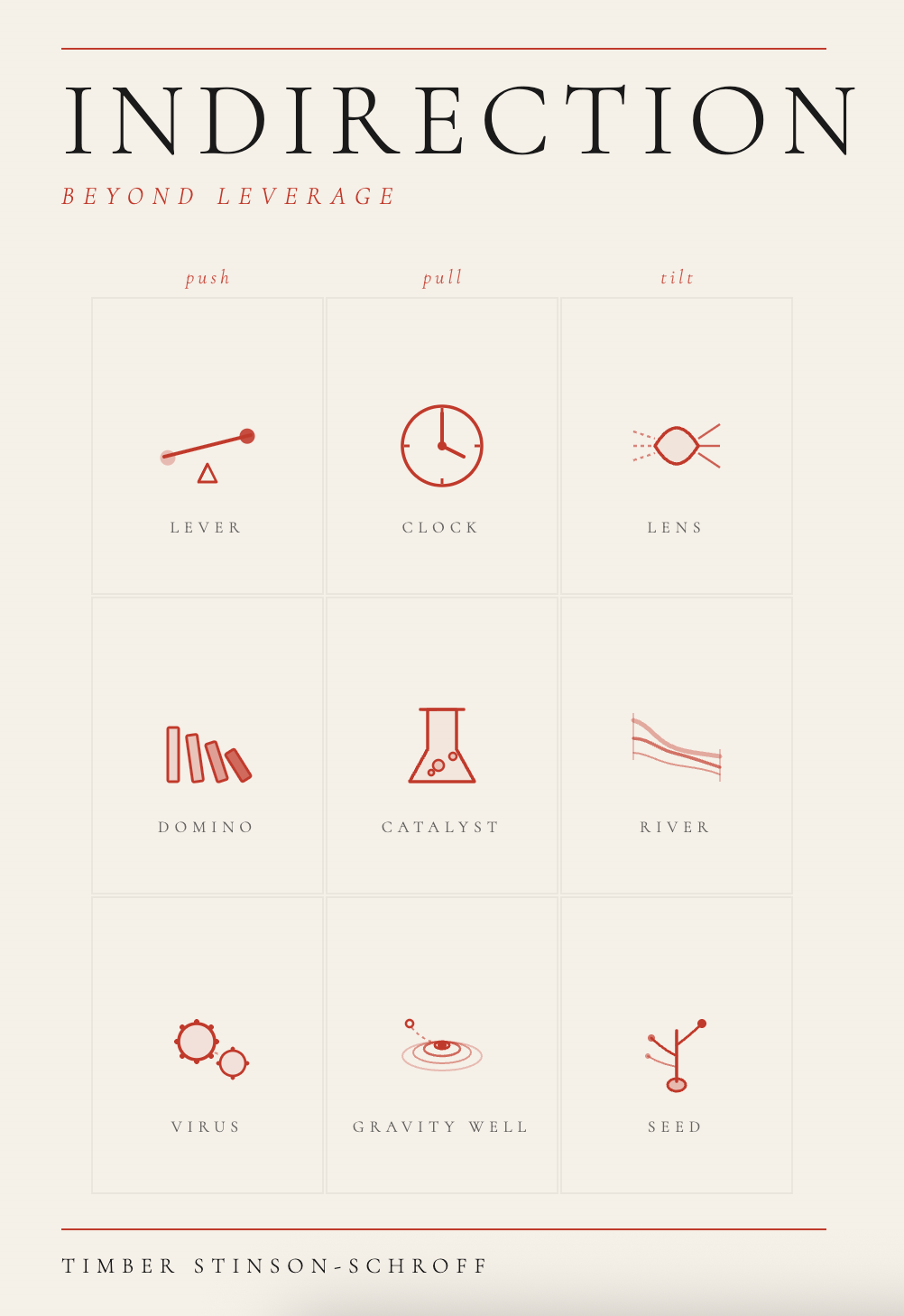
You might already think about indirection in these terms, but I figure most people use just 2 or 3 at MOST. That leaves a lot on the table. The nine images – lever, domino, virus, clock, catalyst, gravity well, lens, river, seed – each illuminate something the others don’t.
After starting to use this framework myself since last November, I can say it’s rounded out my perspective. For example: how could I get more executives to improve their business protocols? A targeted campaign would be direct. But by sketching this idea as a virus, it was intuitive that executives are inoculated against stray information. They tightly control what reaches them. A better target “host” would be the analysts and advisors – the voracious readers that support the executive class. If my image of indirection was stuck as a lever and fulcrum, I doubt that this approach would have come to mind.
Another example: I once ran into a problem when brokering a data sharing agreement between two firms. Approvals stalled on one end. The default approach, had I just tried harder, would have been to continue following up via email or, if push came to shove, escalate the issue. But, by thinking about the issue like a gardening problem, my focus shifted from pushing to growing. We had already planted the seed – that shared data would help improve workplace safety – but we hadn’t invested enough into improving conditions for growth. What ended up fast-tracking the signature process was when I got the two counterparties to bond over their shared love of canoeing. All of a sudden, they were texting, and the problem dissolved! As my colleague Venkatesh Rao likes to say, “Never push on a string.”
My goal is to provide a set of images that rounds out blind spots and increases the depth of available metaphors.
Each month I’ll research one image to better understand its actual dynamics, strengths and weaknesses. I will also interview practitioners whose jobs require them to think competently about indirection. A monthly cadence gives me enough time to do both groundwork and fieldwork, while maintaining a focus on my main project. By the end of the year, I’ll have a complete draft of the monograph.
This grid has a hidden structure. Three rows, three columns, and a taxonomy. I’ll reveal it properly in the first real essay. For now, just let the images sit together. Notice which ones feel familiar and which feel strange. The nine metaphors divide along a surprisingly simple axis that I think will change how you see all of them.
This tempo also lines up nicely with the poll I ran in January. Readers like you stated a preference for monthly posts. Subscribe to Blundercheck and get one email per month with the latest chapter of Indirection.
I’m extremely, selfishly excited to write this and I hope you find it useful as well. This project started as a personal problem: I have more things I want to see happen in the world than I have time or energy to make happen directly. I suspect you might feel the same way.
The serialized version will be free. If you want to help make the final version of the monograph as excellent as possible, sign up for an interview. I’d love to talk to you more about your work and how you think about achieving big goals without, necessarily, applying yourself.
See you next month with the first image. It’s the one you already know – which is precisely why we need to examine it carefully and urgently.
If someone sent you this, you can subscribe to Blundercheck, the home of the Indirection book project, here. If you want to follow my other project, Protocolized is here. Thank you to Ann & Liam for providing feedback on this post.
Have you seen Dave Gray's Visual Frameworks cards? Much like your project, he created a set of 100 visual metaphors to help people think through challenges with ready-made representations of concepts. https://davegray.com/projects/visual-frameworks/
In information design, my field of work, this type of visual and conceptual translation across domains has a long history as an explanatory tool, but interestingly, little has been written about that technique specifically or its use as an "upstream" thinking aid in problem definition and problem solving. Curious to see how your project evolves!
UVic mentioned 🫡🎉