There will never be a perfectly bubble-wrapped world. There will always be risk. There will always be accidents and disasters that we cannot predict or prevent, but must instead respond to. Despite that, striving for zero accidents (colloquially known as Goal Zero) is still the right thing to do – even if it’s technically impossible. Ideals, such as Goal Zero, are necessary to balance out the pursuit of other immediately desirable things, such as productivity and profit. It’s possible, and important, to strive for an ideal while paying attention to its practical limitations. Pure pragmatism leads to ruin and pure safetyism leads to stagnation; the field of occupational health and safety, for example, has failed to shift its focus from accidents to chronic diseases.
Similarly, one of my favorite quotes from T.S. Eliot’s The Rock (h/t Sarah Friend): “dreaming of rules so perfect that no one needs to be good” is a lighthouse for the work I do with the Protocol Institute. In a sense, the ideal of a policy analyst, legislator or manager is a set of perfect rules. Rules that work perfectly, painlessly and in the spirit of which they were originally intended. It’s another impossible and honorable ideal, which has sometimes been tarnished by people taking it extremely literally, but one worth holding onto. Creating good rules is damn hard. Even the best, most perfect rules seem to produce strange results.
A bad encounter with the incompleteness of rules leads some people to change tack. Instead, they focus only on incentives – sticks and carrots – a close cousin of rules. As an instrument for changing behavior or outcomes, incentives are also incomplete; incentives can easily backfire, but for different reasons than rules.
We’re lucky to have both rules and incentives available to us, because their asymmetries make them complementary. Whether to use a rule versus an incentive is a tension, not a choice.
When I initially got inspired to write this, I wasn’t convinced that it was gonna be meaningful. Any time people nitpick over definitions that’s usually a sign that they’re pedantic, not practical. And on the other hand, bashing two concepts together on impulse doesn’t really produce good scholarship, even if the resulting ideas are sexy. I dug into rules vs. incentives anyway, and it did unearth some important stuff.

We should probably start with the 2x2 – the original intrusive thought – that inspired this article to begin with. My mind was on the problem of treasury governance, which is a difficult and pretty much evergreen problem. How do you make sure that a shared pool of money is spent well? Who gets to decide? Obviously, you cannot just rely on someone’s word that they won’t walk off with the money. So you have to either stop them from doing so or make embezzlement more costly than it’s worth.
In other words, you have to create a rule or an incentive. But then comes another set of questions:
Do you specify how to spend the money well? Or do you specify how not to spend it?
Should you deter embezzlement? Or encourage spending on certain things?
These lines of questioning give us the axes of our 2x2, which contains four categories of behavioral interventions. As we’ll see, these categories are leaky – bans, protocols, deterrents, and bounties all fail in reliable ways.
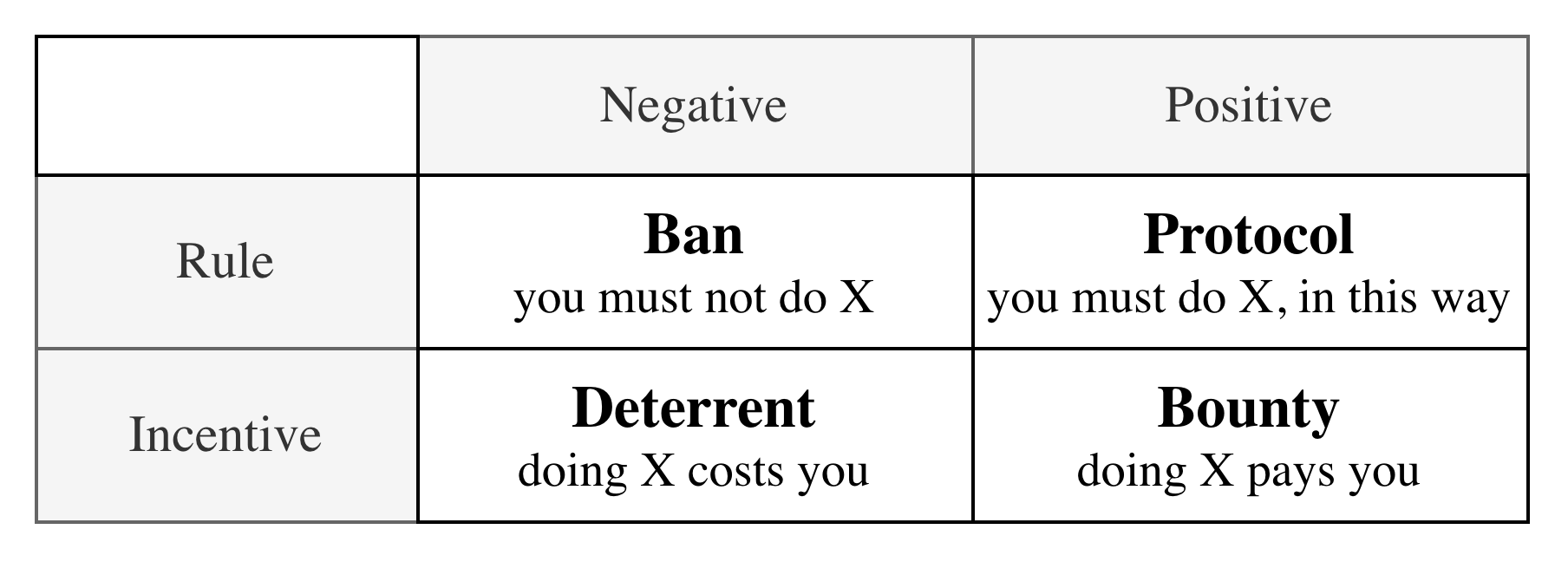
Bans are straightforward and it’s easy for anyone to write one. Protocols are bans with the sign flipped: checklists, procedures, standards, mandated forms, communication etiquette. Bounties include prizes, subsidies, bonuses, and literal bounties. Fines, taxes, tariffs, fees, violence, damage, and other undesirable things are Deterrents.
The difference between negative and positive is easy to grok. Negative rules (bans) are super easy to make, because all you need to do is identify the thing you don’t want to be done. Protocols, which are positive rules, require you to prescribe the desired behavior. That’s a harder task since there are often many ways to do something correctly – plenty of protocol design choices are arbitrary, but still necessary since consensus is so valuable.
The difference between rules and incentives is more nuanced, and has to do with the bounds of their influence. Rules specify methods, but not desired outcomes or aggregate behavior. Incentives affect desired outcomes or outputs, but don’t care about methods. That looks like a simple inversion, but it’s not symmetrical.
Rules apply to you whether or not you’re aware of them, but incentives only work if you’ve noticed them.
We can only be influenced by so many incentives at a time, but rules stack without limit.
Incentives travel across levels of an organization; rules have to be translated.
Rules can easily become incentives; incentives drift into rules slowly.
Perfect compliance causes freezes. Perfect incentive-maxxing causes runaway effects.
Because of these asymmetries, you must use a mix of rules and incentives to create reliable patterns of behavior out of a complex space of possible behaviors. I had many examples in mind when pondering this schema. I’ll go deep on a few to illustrate some finer points.
Where does the complexity go?
Complexity cannot be created or destroyed, only transformed.
A rule bounds the how. Chess has a beautiful example of how rules compartmentalize complexity. In 1972, Tim Krabbé composed a problem in which White promotes a pawn on e8 to a rook, and some moves later castles with it, vertically – the king moving from e1 to e3 and the new rook landing on e2. People who care still argue about it, which is the point: a few pages of rules, complete and unambiguous, and competent readers can’t agree on what they permit.
They agree on this, though. For most of chess history the laws obviously said nothing about mobile devices or computers. Then engines got strong enough to beat anyone alive and small enough to fit in a pocket, and by the 2006 world championship, teams were accusing each other over bathroom breaks. The international chess federation has been patching ever since, banning phones, restricting player movement, screening at events, and a new anti-cheating commission. The rulebook for chess has never gotten shorter, and I don’t know of any rule system with adversarial participants that has shrunk over time.
But the dream of a finished rulebook is certainly alive and well.
A niche but somewhat famous example in tech and business is the 2016 DAO hack where someone drained about $50 million from a digital, autonomous organization by exploiting the treasury’s code. That code, like all code, was made up of rules – both positive and negative – which did exactly what they said they would. That code enforced itself perfectly, and it did not stop someone from exfiltrating the funds.
So it was the spirit of the game which was broken, rather than the rules of the game. This led the majority of those involved to rewrite the code, which was neither a legal remedy nor a remedy found within the DAO’s protocols. It was the social layer reaching around the rules to undo an outcome the rules had produced. A system built to make adjudication unnecessary generated a fifty-million-dollar dispute that was never adjudicated, because the dispute fell outside the bounds of its rules.
The people who refused the fork became Ethereum Classic, on the principle that the rules must stand whatever they produce. Ethereum Classic is the control group: a rule system that declined to patch itself and has been living with the consequences for a decade.
An incentive bounds the what. It either says more of this output, or less of that one. What it leaves unbounded and complex is method. First-order outcomes are simple to state in advance, because an incentive can cleanly map to it and people will move toward the reward. What you cannot predict is how people will get there. The colonial administration in Delhi that paid a bounty per dead cobra got exactly the outcome it specified, more dead cobras, by a method it did not rule out: cobra farming. The result was predictable, but the method was not.
This isn’t to say that rules, a kind of codification, are a bad thing. Mathematician and physicist Stephen Wolfram is an advocate of writing contracts in code – precise, machine-readable, self-executing – but he concedes that once computational irreducibility (complexity) is in play it will typically be impossible to know a contract has no bugs or unintended consequences, and that no finite procedure can check every possibility. He extends it to constitutions: a constitution tries to sculpt what can and can’t happen, but irreducibility guarantees an unbounded set of cases.
Bandwidth Asymmetry, (Un)portability and RI-Drift
When it comes to leveling up how you think about rules and incentives, there are three dynamics worth knowing.
Bandwidth Asymmetry is about how people respond to increasing numbers of rules and incentives, how rulebooks grow, how incentives cannot grow in number, and how incentives are more robust across scales than rules.
Vertical (Un)portability refers to how incentives can move across contexts and along hierarchies in an organization, while rules must be translated.
RI-Drift is about how rules become incentives and, less often, how incentives become rules. I’ve been saying this in my head like “rye drift” since I got tired of saying rule and incentive.
Reflecting on my experience in large and small orgs, and just in day-to-day life, it’s clear that bandwidth asymmetry is a hot topic. Most people I know have encountered a mountain of policy that is impossible to comply with – tax law, occupational health and safety requirements, content guidelines, dress codes, standard operating procedures. Rules stack infinitely, because they are additive by default. A rulebook is like a patchwork quilt. It’s impossible to keep track of all its pieces. There’s a reason that government efficiency initiatives have become increasingly popular, even hack-and-slash ones. People are frustrated with expensive, labyrinthine rule systems where they are permanently stuck in the wrong.
Incentives stack differently. While rules apply regardless of an agent’s awareness of them, incentives function only to the extent that someone knows about them. Therefore, people are only affected by a few exogenous incentives at any given time. Since pursuit of any incentive is optional, any given incentive can be outweighed by a bigger, scarier, or more attractive one. It’s appealing to consider swapping out some rules for a convenient and powerful incentive, but that won’t work on its own. Competing attractors must be assessed either upfront or through trial and error. If an incentive works right out of the gate, it’s probably either overpowered or got lucky with some intense visibility.
Another interesting difference is the vertical portability of incentives, which is a trait that rules don’t have. Rules control behavior directly, which means that they require specific context. “Verify the torque spec before sign-off” is meaningful on the shop floor, but not in the boardroom. A rule can’t be passed upward or downward without translation. Incentives travel well across levels for the same reason that they often backfire: they are a number with no method attached, so each level is free to invent its own path to it. Vertical portability is method-unboundedness.
The last dynamic worth knowing is RI-Drift, which is how rules can leak into incentives.
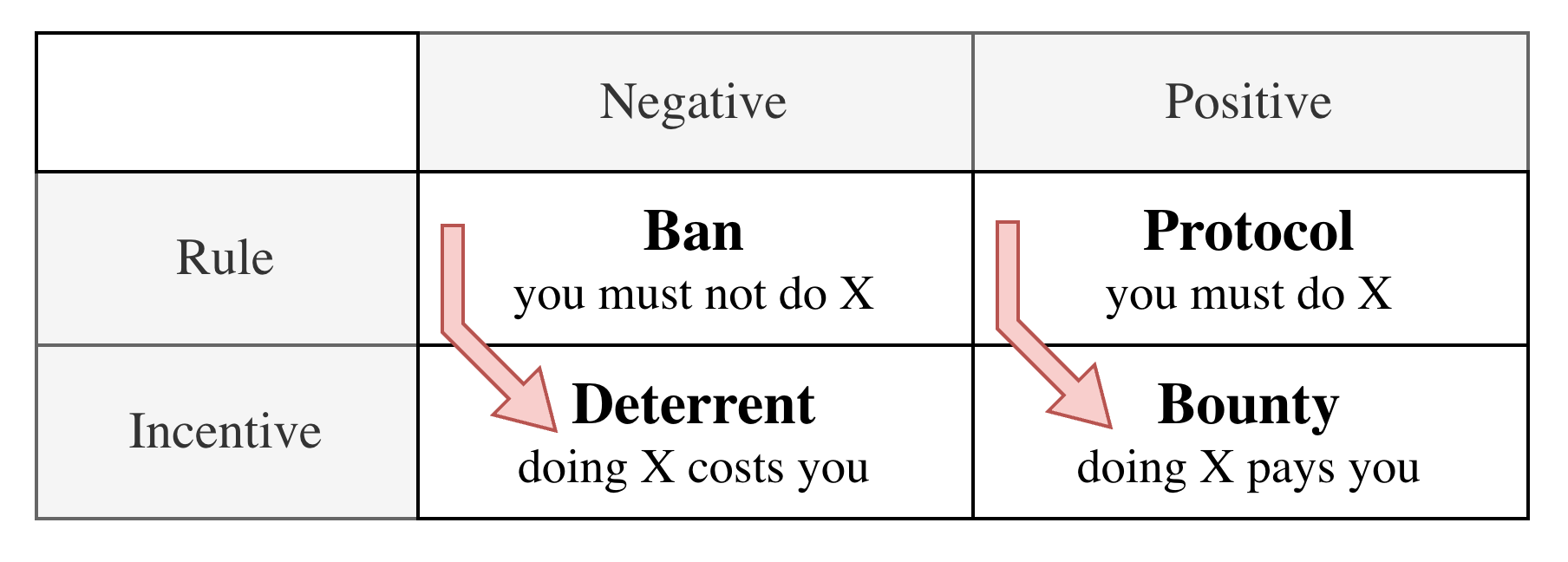
There’s a famous case for bans-to-deterrents. A paper from 2000 studied daycares that introduced a fine for parents who picked up their children late. Late pickups roughly doubled, and stayed high after the fine was removed. The standard reading is that a fine converts a norm into a price. What had been a ban, something you don’t do, became something you can do if you’re willing to pay.
The general version: a ban is only a ban if its penalty is non-purchasable. The moment the penalty becomes a fixed, known, monetary amount, the ban migrates into the deterrent quadrant for every agent whose valuation exceeds the fine. Therefore, a deterrent that is cheaper than the thing it deters is a license. This is why regulatory fines that are small relative to the profit of the violation function as fee schedules, and why the same regulator will eventually be forced back toward penalties that cannot be bought, like disbarment or prison, to restore the ban.
The protocol quadrant drifts as well. A protocol followed perfectly by agents who have stopped caring about its purpose produces a pathology that the field of occupational health and safety is familiar with. Work-as-imagined and work-as-done drift apart, the checklist gets completed and the check does not happen. In the limit, perfect compliance becomes a weapon. The work-to-rule action, where a workforce brings an organization to a halt by doing exactly and only what the rules require, is proof that a protocol followed with total fidelity leaves the behavior of the system entirely open.
Less common, but still possible, is drift from incentives to rules. RI-Drift in this direction is rarer because of the time component – to become rules, incentives either needs time or an institution. Incentives can become rules if they are strong, are universally pursued, require enough verification to breed process, or persist long enough to become expected.
Bandwidth Asymmetry, Vertical (Un)portability and RI-Drift are probably understudied. Policy analysts talk about rules and incentives in terms of carrots, sticks and sermons; managers prefer the terms behavior control and output control; safety professionals call it prescriptive vs. performance-based or means-based vs. ends-based; economists use quantity instruments vs. price instruments. They all see differences between rules and incentives, even if they don’t have a 360o understand the underlying tension in practice. For example, line managers know when to use one or the other, but might lack intuitions for how rules and incentives respond across scale in their organization.
Rule versus incentive is a tension, not a choice
The dream of a finished rulebook persists because it treats rules versus incentives as a decision. Like one can pick the better instrument and commit. But the relationship between rules and incentives is what the protocol studies crowd has been calling a tension: a trade-off plus a conflict.
The trade-off is a technical choice about where you bound the system. Bound the method and complexity accumulates in the rulebook, where it is legible, versioned, arguable, and growing forever. Bound the outcome and complexity accumulates in methods you didn’t anticipate, where it is illegible until it surfaces as a (usually expensive) second-order effect. There is no instrument that avoids both.
The conflict is that different actors want different positions on that trade-off, for structural rather than temperamental reasons.
Whoever carries the enforcement burden prefers rules, because rules externalize the cost of complexity. Rules are cheap to write and the cost falls on the people who have to comply. Whoever carries the execution burden prefers incentives, because incentives leave method open and method is where their expertise lives. Auditors want rules and operators want incentives, and the arguments between them aren’t bad, they’re just not solvable. Rebalancing the underlying trade-off between rules and incentives through repeated conflict is the mechanism by which a system avoids failure due to extremes.
Systems that survive move along the line instead of camping at one end. Emergency response is a clear case: during the incident it’s all protocol, because you need everyone predictable more than you need anyone clever. Once things are stable, incentives take the reins and method opens back up. You tighten the rules when you can’t afford surprises and loosen them when you can.
The outside of a rule isn’t a list of loopholes you could eventually finish closing. It’s everything the rule didn’t mention, and no rule mentions everything. The same is true of incentives, which name a destination and leave every road to it open. Whichever instrument you reach for, something is left unsaid, and whoever is standing there when it surfaces has to decide what to do.
That’s the part Eliot was pointing at. The dream isn’t really of perfect rules — it’s of rules so perfect that no one needs to be good. But every case in this article ends with someone having to be good anyway. When the DAO’s code did exactly what it said and produced a result nobody could live with, the remedy wasn’t in the code. It was a few thousand people deciding, with no rule authorizing it, to reach around the rules. The rules were perfect and somebody still had to be good.
So Goal Zero is the right frame for rule-writing too. You keep building the rulebook knowing it will never be finished, keep tuning the incentives knowing they’ll be gamed, and keep moving between the two as conditions change – not because you expect to arrive, but because the striving is what keeps the system from parking at an extreme. Perfect rules are worth chasing. Just don’t expect them to spare you the judgment call at the end.