
Creativity is like racing. If you go too fast, too soon, you’ll crash. If you overcomplicate things, your efforts won’t compound. The peak of your performance is limited by the quality of your base.
Shortly after Laurie and I met, she signed us up for a half marathon. Like most soccer players, I was prone to boasting about my fitness. Fast forward to the day after the race, when my knees and ankles were so swollen that I could barely walk, and I was no longer feeling so cocky.
But I kept at it. This summer’s training includes six(!) half marathons. Last weekend, I managed to get my big run done while volunteering. Our local ultramarathon, the Raven, is an 80-kilometer race over three mountains. On Saturday I swept for the race, running 32 kms up and across a ridge line, picking up flags and supporting stragglers. This gave me copious amounts of time to ponder the question, “Why the hell do people do this?” shortly followed by, “Yikes…am I one of those people?”
Eight hours constituted a lot of time for my mind to wander, which led to some other, arguably more productive thoughts.
Enduro-Execs
If you haven’t already, one perplexing thing you’ll discover about management executives is that a huge proportion of them are into endurance sports. There are two generations of enduro-execs, but each has a different motivation.
The first generation probably emerged for good reasons. Running is difficult in interesting ways, and it produces interesting benefits: discipline, pain tolerance, a mental connection between easy work and big results, enjoyment of the process, lower blood pressure. Plus, it can just be fun. A lot of people who are into long-distance running / cycling / skiing seem to have traits that make them steady team members in the workplace.
Then you have the second generation, who basically swapped the status game of expensive wine and whiskey out for the status game of Strava and VO2 max estimates. This is more like private school students who get into Harvard or Yale to row crew, even if they’re not that great at math. Yeah, it teaches you some stuff, but it might be more about being in the club than the sport itself.
A key difference between the two generations is how they approach training. Gen I has run or trained for years, accumulating thousands of hours of training and building a good base. Often without much measurement besides “time on feet”. Gen II tries to hack their way to good scores via interval training, gear and gear.
The biggest downside of this is that you can no longer use someone’s interest in endurance sports as a gauge for their ability to go the distance at work. Minus one for the bullshit detector.
Sutherland’s Pyramid
Too much creativity is a bad thing. When you go over to a buddy’s house who’s recently gotten into cooking, but who’s also just watched Chef’s Table… their ambition might put your palate in trouble.
During the Raven, a few types of fast runners stood out:
Actual runners, who had done the work.
New runners, who didn’t know any better.
New and experienced runners, who just couldn’t help themselves but run fast.
That last group suffers from the same problem as overly creative people. They might hit their peak performance sooner, but their peak will not be very high. I’m calling this Sutherland’s Pyramid, because it applies to artists just as much as athletes.
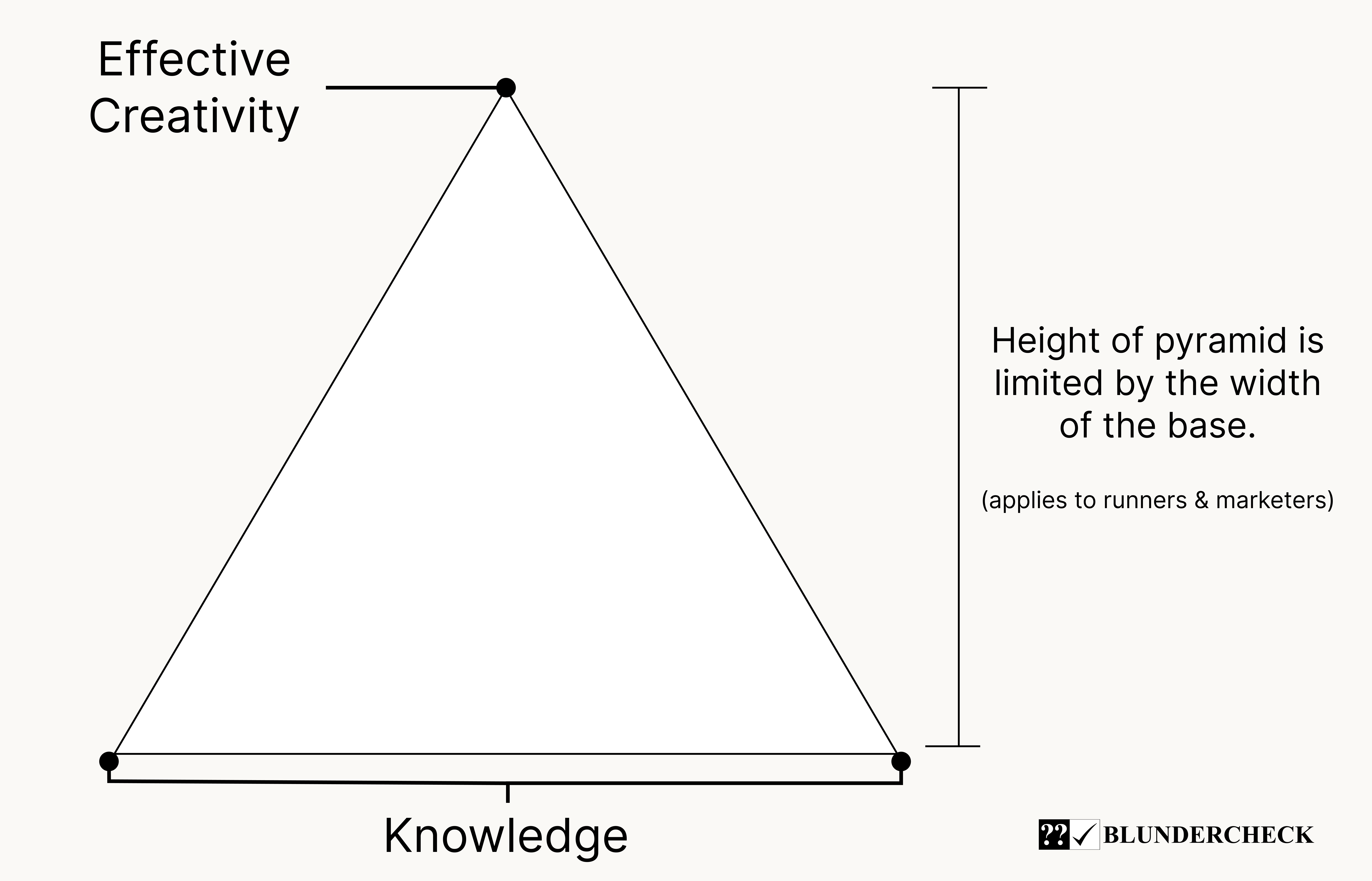
Racing outcomes depend on the quality of your base, which is a factor of how many easy, simple hours of training you’ve put in. Creativity is similarly constrained by your knowledge and real-world experience. Look at any talented marketer and you will see that they spend an enormous amount of time observing the world around them. They are good at their job because they can tell it like it is unlike anyone else. Rory Sutherland, for example, is insanely good about talking about the mundane, quotidian things around us – dishwashers, Coke, speedometers – while making it all interesting. Creativity without a connection to reality is just… bullshit.
Another point about this framework: performance is not about your position on the pyramid. Everyone has their own pyramid. It’s about creating a maximally tall pyramid, which requires you to build a wide, durable base. That means avoiding going too high on the y-axis, which builds up performance debt without contributing much to the accumulation of easy, simple, stackable reps.
Sutherland’s Pyramid is why systems thinking is brain rot for analysts. It’s also why I need to rewrite the About page for Blundercheck. Most of my writing verges on too creative, which means that it’s better suited for people who already have a solid base of experience. I wouldn’t be surprised if it’s worse than useless for self-declared creatives. I’ve found that my most common source of writer’s block is a lack of hands-on experience. The more I feel like I’m bullshitting, the harder it is to write.
If you liked this post, you might enjoy my post on mentabolism.
What's your training protocol these days? I really enjoyed Training for the Uphill Athlete. The value of slow sustained zone two exercise really stuck with me. I enjoy doing slow spinning on my stationary bike during meetings for exactly that reason. Also walking the dogs and taking my little ones around, though less so than when I just had one; then I did some really epic long walks exploring weird nooks and corners of the hill around our condo complex.
Also you might enjoy this piece on the last half marathon I did which I really enjoyed. (I am a sucker for trail running though have had some nontrivial injuries that make that a bit of a fine point.)
https://app.notion.com/p/jotpy/Introduction-to-premium-mediocre-project-management-7a3e8ae75e6e45e1867972318c52fe05?source=copy_link