
In the past week, I’ve been a bit of a masochist. I hiked 54 kilometers with some buddies. We ran out of food, so we finished the adventure lean but otherwise unscathed. Three days later, I ran my first marathon. I finished in under five hours, even after I suffered from gastric shutdown and yurked up about two full liters of gatorade – but that’s not the kind of liquid content I want to talk about.
The third dumb thing I did was post a note about how LLM writing will soon have its “Deep Blue” moment. Already, I would rather consult Claude than go through the horrible experience of reading my Subaru Outback’s brick of an owner’s manual. Anytime I encounter a new machine or tool that I don’t know how to use, I can just snap a photo and ask an LLM. This is exactly how I fixed my dishwasher last month after it started thumping during cycles.
Practical communications, like operating guides, owner’s manuals, software documentation, recipe books and LEGO instructions, are difficult to create. About half of Canadians and Americans fall below high-school reading levels. Technical writers whose job is to help people use their tools face a tension between precision, which requires both verbosity and vocabulary, and accessibility, which requires brevity and familiarity. Creating a singular piece of text that balances that tension is very, very challenging. Fortunately, as demonstrated by my no-longer-thumping dishwasher, LLMs are solving that problem.
If you’re not familiar with Deep Blue, it was a custom IBM supercomputer designed to play chess. One month after I was born, it beat world champion Garry Kasparov in a six-game match. By the mid-2000s, few humans on Earth could beat a top engine in a single game. Today, not a single grandmaster could beat the strongest chess bot on your phone.
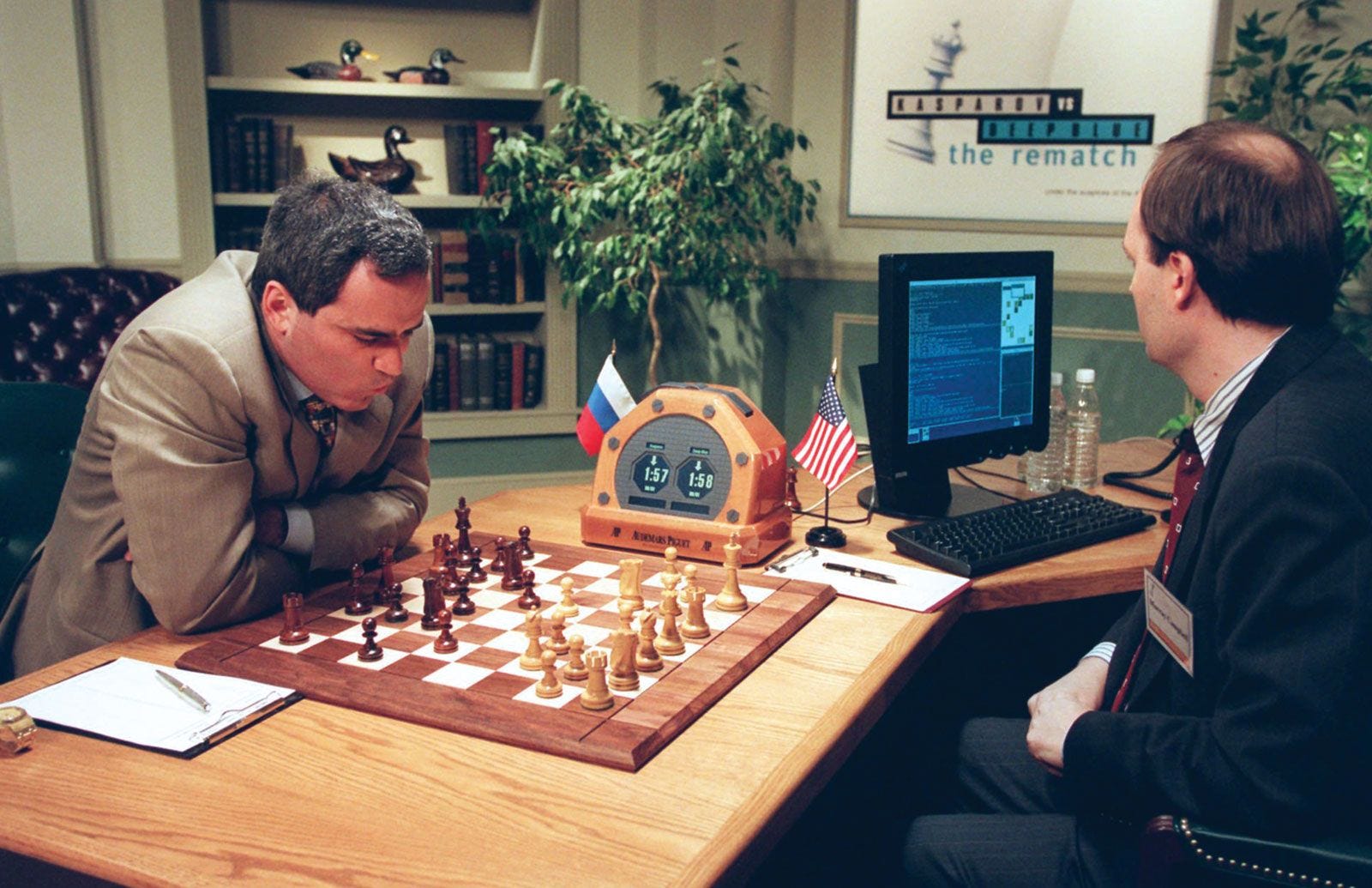
Soon, few technical writers will be able to outperform LLMs when it comes to practical comms about the real world. No surprise that I got a ton of flak when I posted a note saying that. A few people labeled me a shill, saying that AI would never make innovations in literature. Ironically, had they used an LLM to translate my note – committing what they apparently regard as criminal possession of AI writing – they wouldn’t have misinterpreted it.
Literary quality is more subjective than the quality of technical documents. The former can only be judged by whether or not the reader liked reading it; the latter can only be judged by whether or not it helped the reader complete the task at hand. Perhaps for that reason, writing manuals and similar materials is relatively drudging work. Practical communication is a bounded, tedious function that requires ten times as much patience as creativity.
My lay understanding of LLMs is that they’re capable of liquifying what was once solid content into a flexible stream of data, which can be customized based on several factors – including their user’s specific dialect, technical aptitudes or preferred degree of manners. The transition from solid content to liquid content is a win for both consumers and producers.
It constitutes an efficiency gain for businesses, because they can now instantaneously pour content from one container to another (think news outlets, which need to convert stories from audio to text to summaries). And it’s a thoroughness gain for consumers, who can now turn on a tap and get a flow of instructions in real-time, based on the feedback that they’re providing.
Obviously original documentation about microwaves and Subaru emergency brakes still needs to be created. Facts about what things are made of and how they operate can’t be left unspecified. But these things no longer have to be drudgingly written, translated, organized or stylized for human eyes. And readers no longer have to trudge through boring documentation written for a tool’s most lackluster user.
Thus, the paradigm of liquid content relieves a tension that park rangers have wrestled with for decades: it’s impossible to design a perfect bear-proof container when “there is considerable overlap between the smartest bear and the dumbest tourist”.

I expect we’re entering a new golden age for documentation. Even if AI hasn’t yet concretely affected the broader economy, AI is impacting home economics. Almost every day, I hear of people that are now able to initiate and complete projects that would have otherwise required tradesperson. LLMs are YouTube on steroids. They lower the barrier to entry for technical fields. One of my jobs as a kid was to hold wires and operate the breaker while my dad did DIY electrical work around the house. After seeing him shocked several times despite his working knowledge of wiring, I concluded that YouTube was not sufficiently powerful for me to put my local electrician out of a job. But with LLMs, I actually am literate enough to safely solve some problems – like a car battery with a parasitic drain.
One way to look at this is to look at previous shifts in how documentation works. Lisa Gitelman’s Paper Knowledge sequences the history into four episodes: job printing, typescript and near-print, xerography and PDFs. Companies like Adobe were players in the last episode, who made their name by making bits behave like paper. According to Gitelman, the authority of any document depends on its “know-show function” – PDFs were an innovation because they smuggled the fixity of paper into digital substrates, allowing for cheap and fast reproduction of both facts (the “know” function) and instructions (the “show” or teaching function).
Today, that know-show function is decoupling. But how far can that go?
Gitelman edited another book, titled Raw Data is an Oxymoron. Data isn’t a natural resource, but an artificial one that needs to be generated. As LLMs melt the existing landscape of documents into an oozy soup of liquid content, a new layer of fixity will grow. Canonical, versioned, machine-facing documents are still a type of technical writing, even if they are decoupled from the show function. Those docs are what stop your new tutor from hallucinating wire colors and getting you electrocuted, which means that they are an important, valuable asset. We will not see the death of the technical writer, but their work – and the authority of the PDF as a subgenre – is quickly moving upstream.
Companies and governments who create products, infrastructure, nutrition guidelines, assembly instructions or any other type of practical documentation should be transforming how they make such documentation. Customers and constituents will be better off when technical writing turns into a machine-facing role, because the precision-accessibility tension is relieved. Writers can afford to be increasingly precise as LLMs become stronger and readers have infinitely patient, multilingual tutors with access to superior documentation. What Gitelman calls “knowing” is limited by precision and "what she calls “showing” is limited by accessibility. To try and make this essay look smarter, I’ve turned Gitelman’s know-show function into an equation:
Document Utility = Precision x Accessibility
Switching gears into the organizational side of this paradigm shift: the utility of an org’s docs depend on how much they increase the agency of your customers / clients / constituents. If someone’s been hounding you for AI transformation project at work, technical writing is a strong candidate. It’s been clearly validated by anyone with even a drop of DIY in their blood – which is most people – whether they’re doing it to avoid the hassle of contracting a tradesperson, for economic purposes or simply for love of the game.
This shift to liquid content will affect more organizations that it might first appear to. Obvious ones include manufacturers of cars, appliances and furniture – all of which must produce good manuals for their products. But it will also affect more unique organizations, like public health agencies, emergency services and mechanic shops. More and more people will interface with nutrition and exercise guidelines through LLMs rather than consult official government websites. Common triage practices are now used by both first responders and people chatting with their phone, debating an emergency room visit. Newfound ease of preventative maintenance, thanks to liquified mechanic knowledge, could result in hundreds or thousands of dollars in savings.
While some of these gains rest on open-source knowledge created over the past several decades, there exists a clear incentive for knowledge creation. Machines, tools and information products with good, machine-facing documentation will outperform those without. If you take that to the extreme, it’s possible to imagine a world where hardware stores start putting carpenters out of work. I don’t think we’ll get to that extreme, but directionally it’s correct – liquid content is radically increasing people’s agency, moving technical writing upstream and forcing institutions to rebuild fixity.
Time for a new golden age of documentation.
The liquid vs. plastic nature of AI, the conversion of documents into machine-first formats, and the future of trades in an LLM-mediated world are all topics of interest.
A small note about carpentry: the range of minor repairs executable by homeowners will grow and reduce demand for the handyman range of household repairs. OTOH, I have seen apprentices successfully use YouTube to learn new skills, which would likely extrapolate to AI use.
I would hypothesize a K-shaped job market. Tradespeople using technology to deepen their skill sets will continue to find work as they grow their range of competencies. Those who struggle with this approach will become a social and political issue in need of a solution.
Jeez-something missing here. LLMs need to be trained, so a human needs to write those manuals, recipes, etc. First, eh?